Every barrel that doesn’t get produced is a barrel that doesn’t get sold. Simple enough on paper. But talk to anyone who’s actually managed upstream operations, and they’ll tell you the math gets complicated quickly. A piece of kit goes down at the wrong time. Tools need pulling sooner than expected. Tanks are sitting dirty, out of cert, waiting on a crew that’s already stretched across three other jobs. Before you know it, you’re behind on your daily targets and explaining why to people who there weren’t.
Unplanned downtime doesn’t usually announce itself with one big failure. It sneaks in. A skipped inspection here, a vendor relationship that isn’t quite locked in there, repairs that keep getting pushed to next week. None of it feels critical in isolation. Collectively, it chips away at production hours in ways that are genuinely hard to recover from mid-campaign. The frustrating part is that most of it is avoidable, if the maintenance setup is built to catch problems before they become stoppages.
Production teams generally get the connection between reliable equipment and consistent output. Less discussed is the impact on the pace of problem resolution not only of the quality of the actual maintenance, but also of the structure around maintenance.
Reactive maintenance is the same inefficient process, finding a vendor, getting sign-off, getting a crew rolling, waiting for parts, for every unplanned breakdown. On a remote location or offshore, that sequence doesn’t take hours. It takes days. Run through that cycle a handful of times in a quarter and the NPT starts adding up to something that shows up on production reports.
The integrated approach cuts into that cycle at multiple points. When inspection, repair, and certification are handled under one provider, the coordination overhead shrinks considerably. Vendor relationships exist before the breakdown happens. Parts access and crew mobilization aren’t being arranged in a panic at 2am. The work order gets raised and things actually move.
Some equipment failures hurt more than others. In upstream operations, there are three categories that tend to punch above their weight when it comes to maintenance-related downtime:
Frac tanks, acid transporters, nitrogen tanks, these things take a real beating. They’re holding aggressive fluids, getting moved around constantly, and if we’re being honest, they’re usually somewhere near the bottom of the priority list when it comes to scheduled maintenance. That’s fine right up until it isn’t. A tank that fails inspection or drops out of certification mid-campaign doesn’t just create a paperwork problem. It stops work. Whatever that tank was supporting either slows down or shuts down, and you’re now sourcing a fix under pressure.
Drilling jars, stabilizers, shock tools, drilling motors, fluid hammers: these tools work in punishing conditions and are not designed to be neglected. When a downhole tool fails in the hole, the cost isn’t just the repair. It’s the fishing operation, the lost circulation, the rig time. That’s where small inspection gaps become large budget line items.
Systematic downhole tool maintenance follows a structured sequence: visual inspection for thread and surface defects, instrumental inspection to verify dimensional compliance, and maintenance or replacement per type-specific service manuals. For operators running active drilling campaigns, having a service provider with single-source capability across tool types and sizes removes the coordination burden of managing multiple specialty vendors.
Workshop-based work covers a wide range of activities that directly affect field readiness: machining, welding, fabrication, hydraulic maintenance, engine service, electrical work, flange recertification, and more. These aren’t glamorous services, but their cumulative impact on uptime is significant. A hydraulic hose that fails on the wrong piece of equipment at the wrong time can idle a crew for hours. Staying current on workshop-level maintenance is part of what keeps the field moving.
Read Also- Choosing the Right Upstream Oil & Gas Service Partner to Maximize Barrels Per Day (BPD)
There’s a practical argument for outsourcing maintenance operations that goes beyond capability. It comes down to capital allocation.
Building in-house maintenance capacity means hiring and retaining specialized technicians, investing in equipment management systems, managing vendor qualification, and absorbing fixed costs regardless of operational tempo. For most upstream operators, that’s not the best use of capital, particularly when activity levels fluctuate with commodity prices.
Outsourcing to an integrated maintenance provider converts fixed costs into variable ones. You pay for the services you use, when you use them. That flexibility matters in an industry where budgets can shift significantly from one year to the next. It also means scaling up for an active campaign and scaling back during a slower period without the overhead of carrying a full internal maintenance function year-round.
Operators retain full visibility and control of their assets throughout. The difference is that the execution burden shifts to a provider that’s already set up with the systems, personnel, and vendor relationships to handle it efficiently.
GET Global Group’s Integrated Maintenance Solutions are built around a single premise: upstream operators shouldn’t have to manage maintenance complexity on top of everything else they’re managing. With a network of qualified, audited vendors and experienced field employees around the world, GET provides inspection, maintenance and repair services for tanks, downhole tools and workshop services.
It can be partially or fully outsourced as appropriate for the operator. From just adding to an existing team for a campaign spike to complete end-to-end maintenance management, GET fits the bill. The aim is the same in both scenarios: to reduce cost, improve efficiencies and reduce non-productive time.
For operators focused on maintaining daily barrel targets, that’s not a secondary concern. It’s central to how the business performs.
Interested in reducing maintenance-related downtime on your next campaign? Reach out to GET Global Group to explore how their Integrated Maintenance Solutions can support your production goals.
Read Also- The Business Impact of Production Downtime: Strategies to Protect Every Barrel Produced
By Get global | September 9, 2026
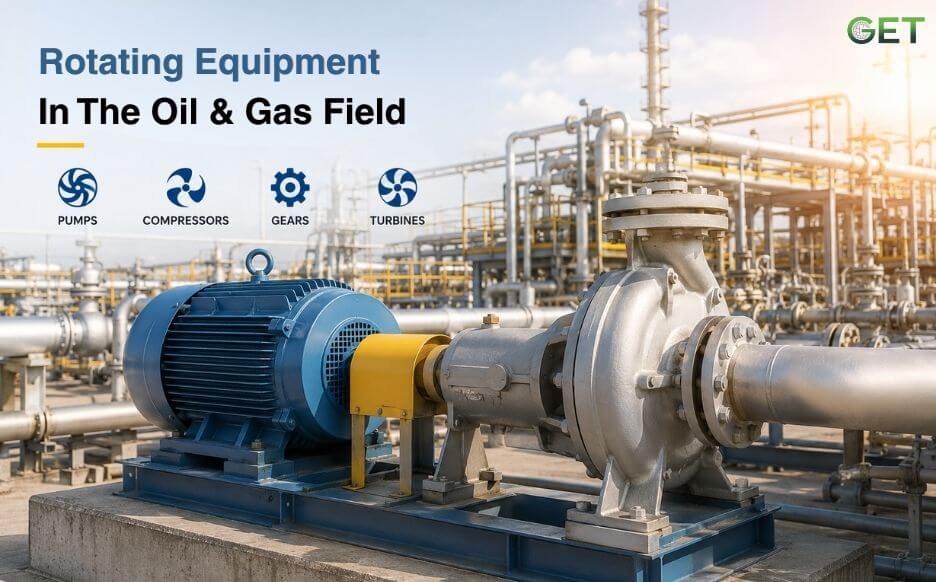
Walk onto any rig floor, production platform, or gas processing plant, and the first thing you notice isn’t the pipework – it’s the sound. That low, constant hum coming from somewhere in the facility is almost always rotating equipment doing its job. Pumps pushing fluid through miles of pipeline. Compressors […]

By Get global | September 9, 2026

By Get global | September 9, 2026
An offshore rig losing production can bleed staggering sums for every hour it sits idle. On the other end of the same industry, a well-run inspection or maintenance contract just keeps collecting steady, contract-locked revenue for a decade, without ever touching a barrel of crude. Same industry. Same oil underneath […]

By Get global | September 9, 2026
By Get global | September 9, 2026